

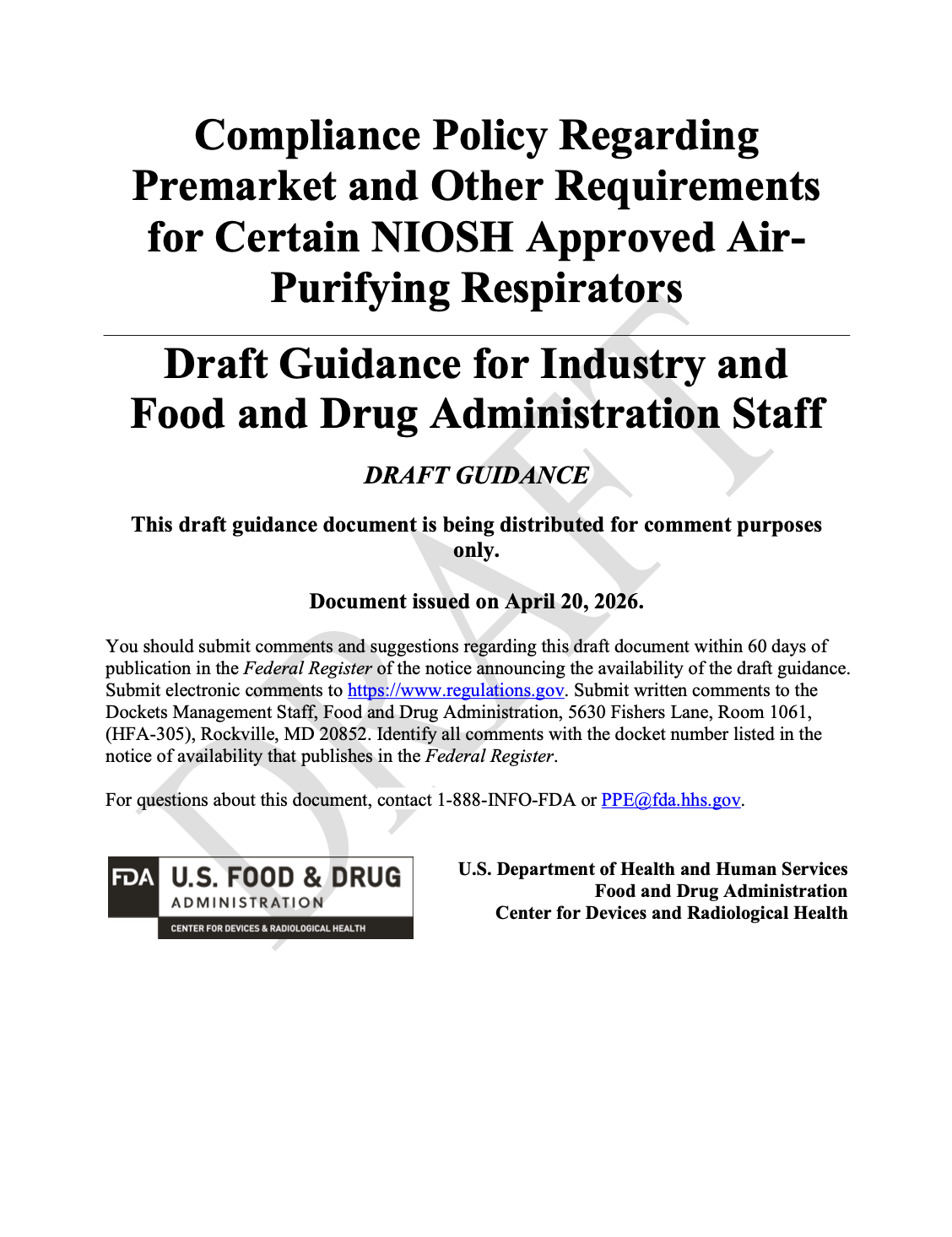
FDA just dropped a draft guidance that could significantly reduce the regulatory burden for respirator manufacturers.
The new "Compliance Policy Regarding Premarket and Other Requirements for Certain NIOSH Approved Air-Purifying Respirators" (issued April 20, 2026) proposes that FDA will not prioritize enforcement of certain premarket and other FD&C Act requirements for NIOSH-approved respirators used in healthcare settings.
In plain English: if NIOSH already approved your respirator, FDA is proposing to largely step back from duplicating that oversight.
Three device categories are in scope
Surgical N95s and N95 FFRs (21 CFR 878.4040), other NIOSH-approved non-surgical respirators (PAPRs, reusable elastomerics, non-powered particulate FFRs), and FFRs for general public use in public health emergencies (21 CFR 880.6260).
FDA is deferring to NIOSH's oversight framework
The rationale: NIOSH already requires site qualification, quality control plans, conformity assessments every two years, and postmarket evaluations. FDA reviewed MDR data from January 2020 to December 2024 for these devices and found zero safety signals.
Not everything is exempt
FDA still expects manufacturers to comply with recordkeeping and complaint handling under 21 CFR 820.35, MDR requirements (21 CFR 803), UDI requirements, and Reports of Corrections and Removals (21 CFR 806). The enforcement discretion covers registration, listing, premarket notification, labeling, and QMS requirements beyond recordkeeping.
Some products are explicitly out of scope
N95s with antimicrobial or antiviral agents, products making infection prevention or viral filtration claims, devices with antimicrobial coatings, nanotechnology, or drug delivery systems. If your respirator does more than filter, you are still on the standard pathway.
The bottom line: FDA is formalizing what was already happening in practice. NIOSH oversight is robust enough that duplicating it at FDA creates burden without added safety benefit. For manufacturers of standard NIOSH-approved respirators, this means a simpler compliance picture.
Qalico has indexed this guidance so our users can track it alongside their existing regulatory landscape.